
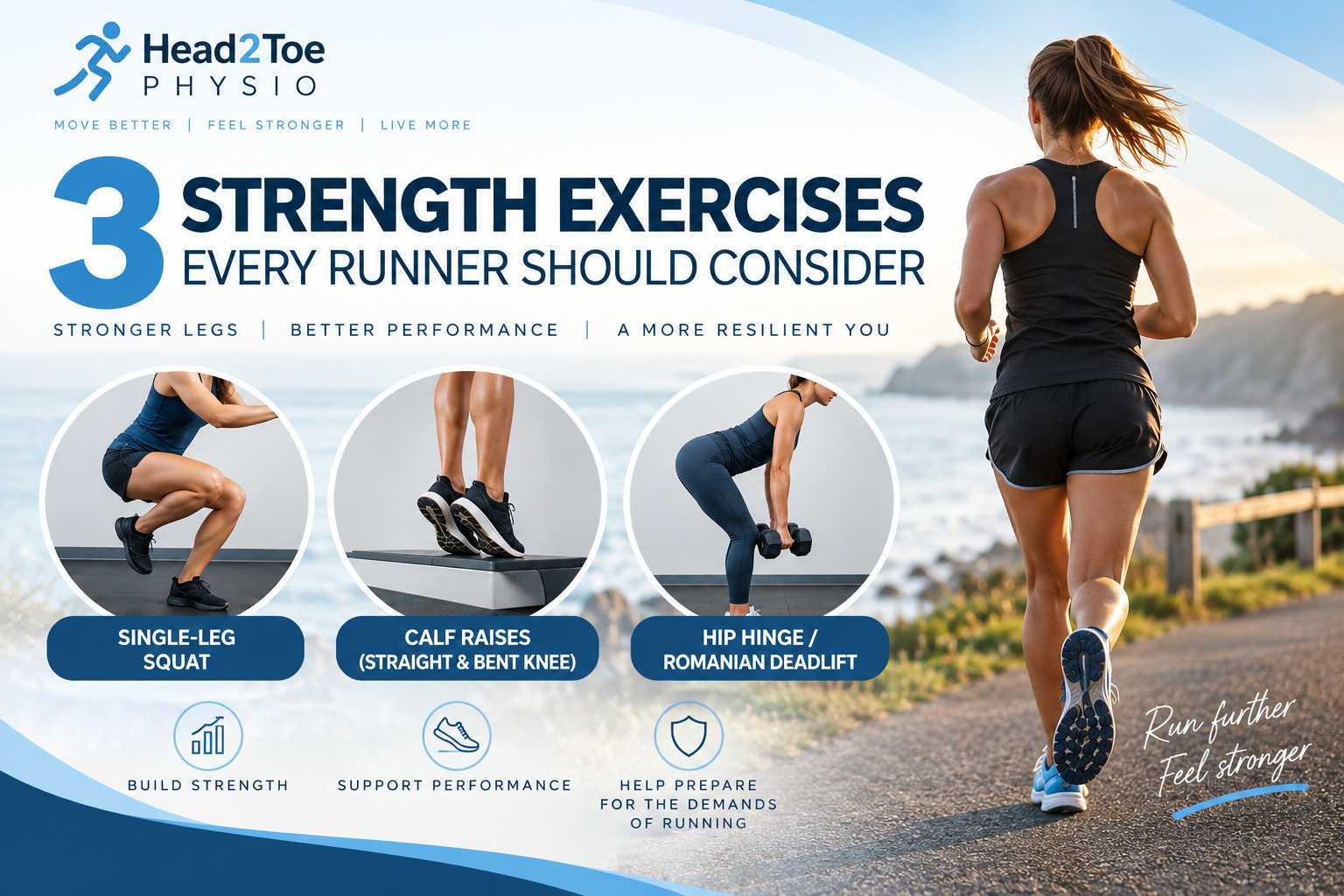
Three Useful Strength Exercises for Runners
Running might look simple, but every stride places significant load through your legs. Strength is only one part of improving running performance and managing injury risk, but improving the capacity of the calf, thigh and hip muscles can help prepare your body for the demands of running.
Research also suggests that lower-limb resistance training can improve running economy. In simple terms, running economy is the amount of energy you use to run at a given pace. Improving running economy can therefore be particularly useful for running performance.
At our clinics, one of the common things we see is runners who run regularly but do very little strength training.
The good news is that you don’t need a complicated gym routine. A few well-chosen exercises, performed consistently and progressed over time, can be a useful addition to your running programme.
Here are three useful strength exercises for runners. You can also find video demonstrations across our social media showing you how to perform each exercise.
1. Single-Leg Squat
Why does it matter?
Running involves repeatedly absorbing and producing force through one leg at a time. The single-leg squat is a useful way of developing strength through the hip and knee while also challenging balance and single-leg control.
Developing good single-leg strength can be particularly useful as the demands of running increase, such as when running faster, uphill or when fatigued.
What does it target?
- Glutes
- Quadriceps
- Single-leg strength
- Balance and coordination
- Hip, knee and trunk control
How do I do it?
- Stand on one leg.
- Slowly lower yourself into a squat.
- Allow your knee to move naturally while keeping the movement controlled.
- Keep your pelvis and trunk controlled.
- Push through the floor to return to standing.
- Perform the movement slowly and with control.
If a full single-leg squat is too challenging, start with a supported version or reduce the depth. As you become stronger, gradually increase the depth and then add external resistance.
2. Calf Raises – Straight and Bent Knee
Why do they matter?
Your calf muscles play an important role in running. They help produce force and manage the repeated loading that occurs with every stride.
It is useful to train the calf with both a straight and bent knee, as this changes the relative contribution of the two major calf muscles:
Straight knee → greater emphasis on the gastrocnemius
Bent knee → greater emphasis on the soleus
How do I do them?
- Start with single-leg calf raises on the floor.
- Progress to performing them from a step if appropriate.
- Rise up over approximately 2 seconds.
- Lower slowly over approximately 3 seconds.
- Keep the movement controlled and work through a comfortable range.
- As you become stronger, gradually increase the resistance.
This could mean holding a dumbbell, using a weighted backpack or progressing to a calf-raise machine in the gym.
3. Hip Hinge / Romanian Deadlift (RDL)
Why does it matter?
The Romanian deadlift is a useful hip-dominant exercise that develops strength through the posterior chain, particularly the glutes and hamstrings, while also challenging trunk strength and control.
It can be a useful addition for runners looking to develop general lower-limb strength alongside their running training.
How do I do it?
- Hold a weight, or start with bodyweight while learning the movement.
- Stand with a slight bend in your knees.
- Push your hips backwards while maintaining a comfortable spinal position.
- Keep the weight close to your body.
- Lower until you feel tension through your hamstrings.
- Drive your hips forwards to return to standing.
- Keep the movement controlled throughout.
Once you are comfortable with the movement, gradually increase the resistance.
How Much Strength Training Should Runners Do?
You don’t need to spend hours in the gym to benefit from strength training, and there isn’t one programme that is right for every runner.
The amount and type of strength training you need will depend on your running experience, goals, current training and injury history.
For many runners, two strength sessions per week can be a useful starting point. Research involving middle- and long-distance runners suggests that incorporating strength training alongside running can improve running-related performance measures, including running economy.
As a practical general guide:
- For many exercises, 6–12 challenging repetitions is a useful starting point, although effective strength training can use both lower and higher repetition ranges.
- Aim for approximately 2–3 sets per exercise, depending on the exercise, your experience and the rest of your training programme.
- The final repetitions should feel challenging while still allowing you to maintain good technique.
- A useful target is to finish most sets feeling that you could perform approximately 2–3 more repetitions if required. This is often described as having 2–3 ‘repetitions in reserve’ (RIR).
- You don’t need to routinely train to complete muscular failure to become stronger.
Most importantly, strength training needs to be progressive. As an exercise becomes easier, gradually increase the resistance, repetitions, range of movement or difficulty.
Strength Training and Running Injuries
Strength training isn’t about replacing your running. It is about developing some of the physical capacity required to tolerate and perform the activity.
It is also important to remember that strength is only one part of the picture when it comes to running injuries.
Changes in training load, previous injuries, recovery, sleep, running experience, general health and tissue capacity can all play a role.
Rather than thinking of strength training as a guarantee against injury, think of it as one part of a broader approach to preparing your body for the demands of running.
How Can Head2Toe Physio Help?
Across our three clinics, we assess and treat a wide range of everyday and running-related injuries. We also offer a bespoke Running Clinic for runners looking for a more detailed assessment.
As part of the Running Clinic, we can look at:
- Your current running programme
- Training frequency and volume
- Running goals
- Previous and current injuries
- Strength and movement
- Running technique
We then carry out a comprehensive physical assessment alongside running gait analysis using specialised software.
We use this information to understand how you are currently moving and identify factors that may be relevant to your symptoms, performance or training. From there, we can provide tailored advice and an individualised plan to help you manage your training and work towards your running goals.
Want to know whether your strength, running technique or training programme could be improved?
Get in touch with Head2Toe Physio to find out more about our Running Clinic.
And don’t forget to check out our social media for demonstrations of these exercises and our other blogs covering topics such as running recovery, returning to running and common race-day mistakes.
References
Effect of Strength Training Programs in Middle- and Long-Distance Runners’ Economy at Different Running Speeds: A Systematic Review with Meta-analysis.
American College of Sports Medicine Position Stand: Resistance Training Prescription for Muscle Function, Hypertrophy, and Physical Performance in Healthy Adults: An Overview of Reviews.